

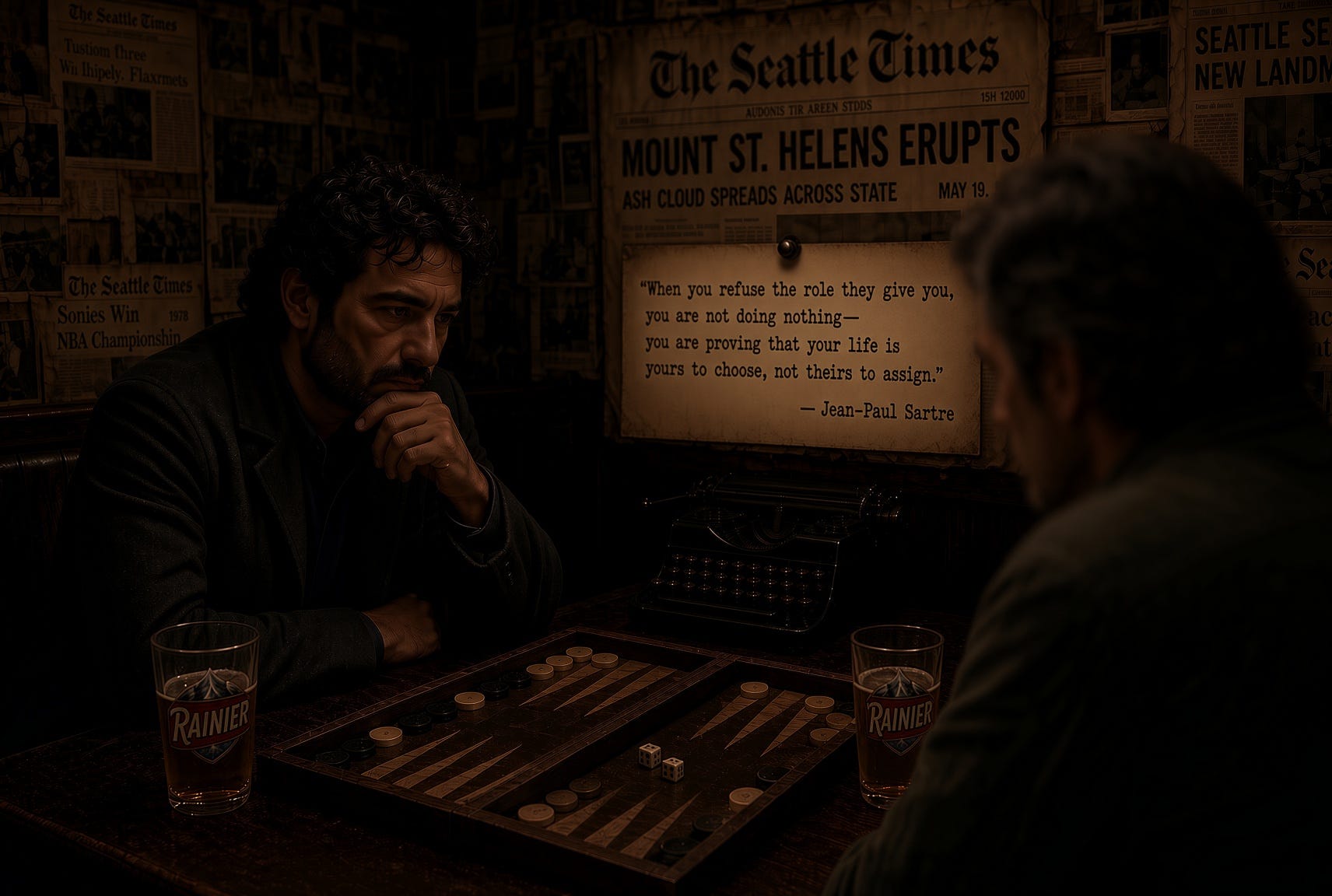
A: I’ve always believed we arrive as a blank page. Whatever we become- careful or reckless, quiet or commanding- comes from what happens to us. Family, school, the streets we walk, the stories we hear. Change the environment and you change the person. That’s the hopeful part. We can become almost anything we set our minds to.
B: I used to think the same. Then I started noticing how early some things already feel set. Not skills. Those can be learned. But the deeper posture. The one who steps forward when everyone else freezes. The one who can’t stand being told what to do. The one who seems to remember something the rest of us never knew. It doesn’t feel written by the environment. It feels older.
A: Older how? You’re not saying we’re born already finished.
B: Not finished. Predisposed. The oldest stories we still have keep saying it. In the Atra-Hasis the gods set destinies before they ever make humans. They mix clay with divine blood so certain tasks get carried. The Hermetic piece, Poimandres, says the human receives a nature before it even opens its eyes on earth. I’m not calling that laboratory science. I’m saying it might be the earliest language we have for something a lot of us still feel — that some shapes arrive with us, and the environment only fills them in.
A: So you’re picking myth over the blank-slate view.
B: I’m trying to hold both. The blank-slate keeps us free and responsible. The older view keeps us honest about the limits of that freedom. Maybe a new reading of the oldest memory can let us keep both without lying to ourselves.
A: All right. Let’s hear it. You’re saying those old stories aren’t just stories. They’re trying to tell us something about how we’re already shaped before we start writing on the page.
B: Yeah. And the Sumerian tablets weren’t meant to be read only in a literal way, there is room for imagination. They were written so each age could look into them and find what it needed. The meanings stay partly hidden on purpose. Like tools that only show their full use when the right questions get asked. Our age is asking about fate, and why some people feel driven from the inside while others just take the orders they’re given. The tablets are ready for that question.
A: Go on.
B: Take the ancient gods. Most people treat them like distant objects- powerful beings out there somewhere that nobody’s ever really seen. Obey the rules, make it to the good place. What if that was never the main point? What if the gods were a way of describing different forces already moving inside people? Not personalities we pick like clothes. Patterns already sitting in the character. You don’t wake up one morning and decide to be the one who keeps order, or the one who works the ground, or the one who has to carry old knowledge forward. Those postures are already there. On purpose. No coincidence. Just waiting to be recognized.
A: So the gods are… mirrors?
B: Something like that. A way to see the pattern outside yourself first, so you can recognize it inside. In the old accounts the higher ones set destinies, mixed clay with a spark of the divine, assigned tasks, enough to give homo Erectus the intelligence to follow orders, and safe guard it with desire to prevent manic depression. And left certain spirits to watch or to wander. Like Later ages turned all of it into religions or threw it out as superstition. I’m saying we can read them again as an early map of the different ways a human psyche can lean. Seven, with 2 additions of lasting postures that keep showing up no matter how much the environment changes.
A: So 9 types of humans?
B: A working number. The earliest records give you the worker made to carry the load, the restless ones who refuse physical labors, the one who brings knowledge down, the mediator who stands between, the one who completes and organizes, the keeper of records, and the guardian. With the addition of two spirit forms as a residual presence that carries something older, and the liminal one who walks the edge. None of these archetypal types is better than the others. Just different. Most of us live more than one. However, there is one prominent characteristic that sits closest to the center.
A: You’re not saying we’re programmed and free will is off the table, are you?
B: Not completely. Environment still writes a lot. But there’s a deeper layer that already has its own lean. Think of consciousness as the passenger. It’s there, watching. The deeper posture is more like the driver. When the road splits, the passenger can notice and grab the wheel — but the car was already drifting a certain way. Once you see that, the whole game feels different.
A: I get what you’re driving at. Most of us just coast and never notice the pattern. So show me how one of those drivers looks in ordinary life.
B: Start with the ones who were already there before us — the Igigi. Junior gods, something like the Titans. The senior ones put them on the heavy labor. They work until they can’t, then they refuse. That refusal is the first real crack in the system.
A: So the rebellion is what made humans necessary.
B: Right. The higher ones still need the work done, so they make a new being for it — the lullu. Clay and divine blood. Mortal. Built for the daily load. In ordinary life these are the people who feel most themselves when they’re building, fixing, providing, keeping the ordinary world running. They measure a day by what holds together. Take the meaningful work away and something in them starts to thin out. They’re not looking for philosophical debates. A good day’s work, something to belong to, a family life — that’s enough.
A: I know a lot of people like that. Across every background. Are there types that aren’t built that way?
B: Fewer, but they’re there. Once humans exist, that restless Igigi quality doesn’t disappear. It just changes form. Later stories- Enoch, the sons of God- talk about a mixed lineage, the Nephilim, the mighty ones. I read that as the same restless current finding a new channel. Not a separate species. Just human beings in whom the original refusal still runs strong. The ones who feel the walls closing in and push. Defiant when something feels forced. They can’t stay quietly under a load that feels wrong. Due to the mixing of genes, their descendants inherits both- the capacity for steady work and the capacity to refuse it. Most people live somewhere between. A few sit close to one pole or the other.
A: Okay. I’m with you.
B: Then there’s the one who brings knowledge down without fully belonging to either side. Adapa. Someone receives something- insight, craft, warning- and feels compelled to pass it on, even when it costs. You see the same pattern with Enki, with Prometheus, even in the Genesis garden story. The gift changes everything. The giver usually pays for it. These people are often quieter. They change the temperature of a room without trying. Crowds drain them. A lot of them dig deep into religious or comparative study and then step away from organized forms because they need the solitude.
A: I’m starting to see how these sit under ordinary faces.
B: Keep going with me. The en- the old title for the one who stood between the divine messengers and the people. In daily life it’s the person who feels called to hold space for others. They can lift a room or make someone feel actually seen. The cost is real. They empty out. They need silence, music, or some kind of ordered rhythm to fill back up. People trust them easily. That’s both the gift and the danger. Power likes to sit with them. They have to stay grounded or it turns.
A: I’ve watched people burn out exactly that way.
B: Next to that is the sar- the completer. The one who sees the whole shape and steps into the empty space where order is missing. They organize almost without deciding to. Under pressure they get clearer, not smaller. People give them room when they walk in. They can start treating ordinary lives like pieces on a board. History tends to get written from their chair.
A: And the ones who keep the record straight?
B: The ummânu. The master, the scribe, the living archive. They love accuracy the way other people love music. Inaccuracy bothers them in the body. They collect, correct, teach, and quietly make sure things aren’t forgotten. They don’t need the spotlight. They need the record to be right. In a noisy age they can look slow or too exact. They’re also the reason whole stretches of knowledge survive without getting completely rewritten.
A: I’m starting to see how the shoe fits different people I know.
B: Good. One more from that older design- the alad. These people scan a room even when they’re sitting still. Durable. Loyal. Willing to put themselves between danger and whoever they’ve claimed. They don’t need thanks. They need the people they protect to be safe. Force is acceptable if it has to be, but they’d rather it never comes to that. First responders, military, the friend who always shows up when things get hard.
And the last two are different in a peculiar way. They sit a little outside the original work-order story. The eṭemmu is residual presence. the sense that something older is riding along. Eyes or instincts that feel older than the years on the face. Skills that arrive faster than they should. Judgments with a weight that doesn’t match the biography. Identity can feel layered, often left feeling they are something other than what they were born as. The gift is depth. The risk is forgetting which life you’re actually living.
And the zaqiqu- the liminal one, the edge-walker. They notice what the rest of us filter out. Timing, language, ideas sit slightly outside the current age. Originally it meant a dream spirit, something that moves between ordinary reality and whatever is next to it. These people often get misunderstood or sidelined. Their contribution shows up in visionary, artistic, or mystical work- especially when an old set of categories is falling apart and a new one hasn’t formed yet.
A: So these aren’t characteristics we just develop through our environment. More like a costume we put on?
B: Not the costume. More like what wears the costume. Culture and identity are the clothes. The deeper posture is already leaning a certain way before you start dressing it. Consciousness can still grab the wheel. You can wake up and choose. But the pressure on the wheel is different depending on which way the car was already drifting. That’s the claim. Not that we’re locked in. Only that we’re not as blank, or as fully in control of our first reactions, as we were taught to believe.
A: All right. I want to sit with that before we go further.
——————————————————————————————————————
Here is a summary of the subconscious / sub-character this theory holds. Which one are you? Do you see these traits with the people in your life, with your colleagues at your workplace or social group?
1. Igigi — The Restless / Boundary-Crosser
This posture begins in refusal. In the old account the junior gods are given the heavy labor and eventually reject it. The same lean appears in people who feel constraint early and push against it.
Everyday signs: discomfort with rigid hierarchy, quick detection of forced or hollow systems, a drive to open space where none is offered. They may become innovators, whistle-blowers, explorers, or chronic dissenters.
Gift: they keep a culture from hardening into pure obedience.
Shadow: restlessness that never settles, disruption without a workable replacement, difficulty accepting any external limit.
Environment still shapes how the refusal is expressed — constructive or purely reactive — but the underlying refusal itself rarely disappears.
2. Lullû — The Grounded Builder
Created to carry the load the Igigi refused. Oriented toward tangible production, maintenance, and continuity.
Everyday signs: satisfaction in work that has a clear result, loyalty to family and practical community, a sense of worth tied to what has been built or kept intact. When meaningful work is removed, something in them thins. They are rarely drawn to abstract debate for its own sake.
Gift: they keep ordinary life functioning.
Shadow: can become identified with the load itself, resistant to necessary change, or lost when the work loses meaning.
The environment determines whether their labor feels dignified or exploited, but the orientation toward steady contribution remains.
3. Adapa — The Knowledge Mediator / Culture-Bringer
The one who receives something from a higher or deeper source and feels compelled to hand it on, usually at personal cost. Parallel patterns appear with Enki, Prometheus, and the garden story in Genesis.
Everyday signs: quiet intensity, a sense of carrying material that does not fully belong to the ordinary world, discomfort in large unstructured gatherings, deep engagement with meaning systems followed by a need to step back from them. They change the temperature of a room without performing.
Gift: transmission of transformative knowledge or craft.
Shadow: isolation, the burden of knowing more than can easily be shared, repeated patterns of giving and then withdrawing.
Environment influences whether the gift is welcomed or punished, but the compulsion to mediate remains.
4. En — The Mediator / Space-Holder
The old title for the one who stood between the divine and the human community. In daily life this is the person who feels called to hold space for others.
Everyday signs: ability to make people feel seen, capacity to lift the emotional tone of a group, a strong sense of service or calling, rapid depletion after prolonged giving. Recovery usually requires silence, music, ordered rhythm, or withdrawal to quieter places. Trust comes to them easily.
Gift: they make collective meaning and care possible.
Shadow: burnout, difficulty setting boundaries, attraction of power that can corrupt the original call.
Environment determines whether their service is supported or endlessly extracted.
5. Šár — The Completer / Organizer
Oriented toward the whole rather than the part. Steps into vacuums of order almost automatically.
Everyday signs: clarity under pressure, rapid assumption of leadership when structure is missing, ability to see systemic patterns, a presence that makes others give space. Emotion is often managed rather than freely expressed. Can feel lonely even when surrounded by people.
Gift: turns chaos into workable order at scale.
Shadow: distance from ordinary lives, treating people as pieces on a board, difficulty accepting limits, quiet hunger for control. History is frequently written from this vantage.
Environment shapes the scale on which they operate, but the organizing drive itself is prior.
6. Ummânu — The Keeper of Knowledge
The master, scribe, living archive. Oriented toward accuracy and continuity of what must not be lost.
Everyday signs: physical discomfort at inaccuracy, strong collecting and correcting impulse, preference for precision over performance, quiet teaching or preservation work. They do not need the spotlight; they need the record to remain reliable.
Gift: prevent cultural and intellectual amnesia.
Shadow: can become rigid, overly exacting, or slow to accept necessary new formulations.
Environment determines what knowledge is available to preserve, but the orientation toward faithful transmission remains.
7. Alad — The Protective Guardian
Watchful loyalty and endurance. The old protective spirit that stands between harm and what has been claimed.
Everyday signs: constant low-level scanning of the environment, physical durability, deep loyalty once attachment is formed, willingness to place themselves between danger and others. They prefer that force not be needed, yet accept it when it is. Love is expressed primarily as protection.
Gift: safety and steady presence for those they guard.
Shadow: difficulty standing down, over-identification with the protector role, distress when they cannot prevent harm.
Environment shapes what they are asked to protect and how, but the vigilant posture is already present.
8. Eṭemmu — The Residual Presence
The sense that something older rides along with the present life. Not a full second personality, but a layered quality of instinct, memory, and weight.
Everyday signs: eyes or manner that feel older than chronological age, skills or judgments that arrive faster than ordinary experience would explain, sensitivity to places of long habitation or death, periods when identity feels less solid.
Gift: unusual depth and continuity of instinct.
Shadow: confusion about which impulses belong to the present life, difficulty forming a stable single identity, emotional residue that does not match current biography.
Environment can either help integrate the residual layer or pathologize it.
9. Zaqīqu — The Liminal / Edge-Walker
Perception that sits slightly outside the dominant consensus of its time. Originally a dream-spirit or fleeting presence that moves between ordinary and non-ordinary reality.
Everyday signs: noticing what others filter out, ideas or timing that feel untimely, shifts in the meaning of ordinary language, frequent misunderstanding or social isolation. Contribution tends to appear in visionary, artistic, poetic, or mystical work, especially when an age’s categories are dissolving.
Gift: brings perception that an old order cannot generate from within itself.
Shadow: chronic alienation, difficulty translating experience into shared language, vulnerability to being dismissed or pathologized.
Environment determines whether the edge-walker is given any place at the table or left entirely outside.
*This theory is built off of and inspired by The Ancient Seal, from Youtube.
Interesting thanks . Reminded me of worldwide myths regarding shaman and smith (brothers/twins) and also loosely of the old humors (melancholic , sanguine, phlegmatic , and choleric) and how those might relate to the archetypes you mention - as for free will - I don’t believe in it any more although like you I am open to the idea of some room somewhere on that but nature v nurture - I agree nature or predestiny does affect who we are / not just environment ,.,
"Consciousness as the passenger, the deeper posture as the driver" is a genuine complication worth sitting with rather than smoothing over. My own language leans toward will as discovered through attention, implying real freedom in the discovering.